Surface enumeration
Workflow
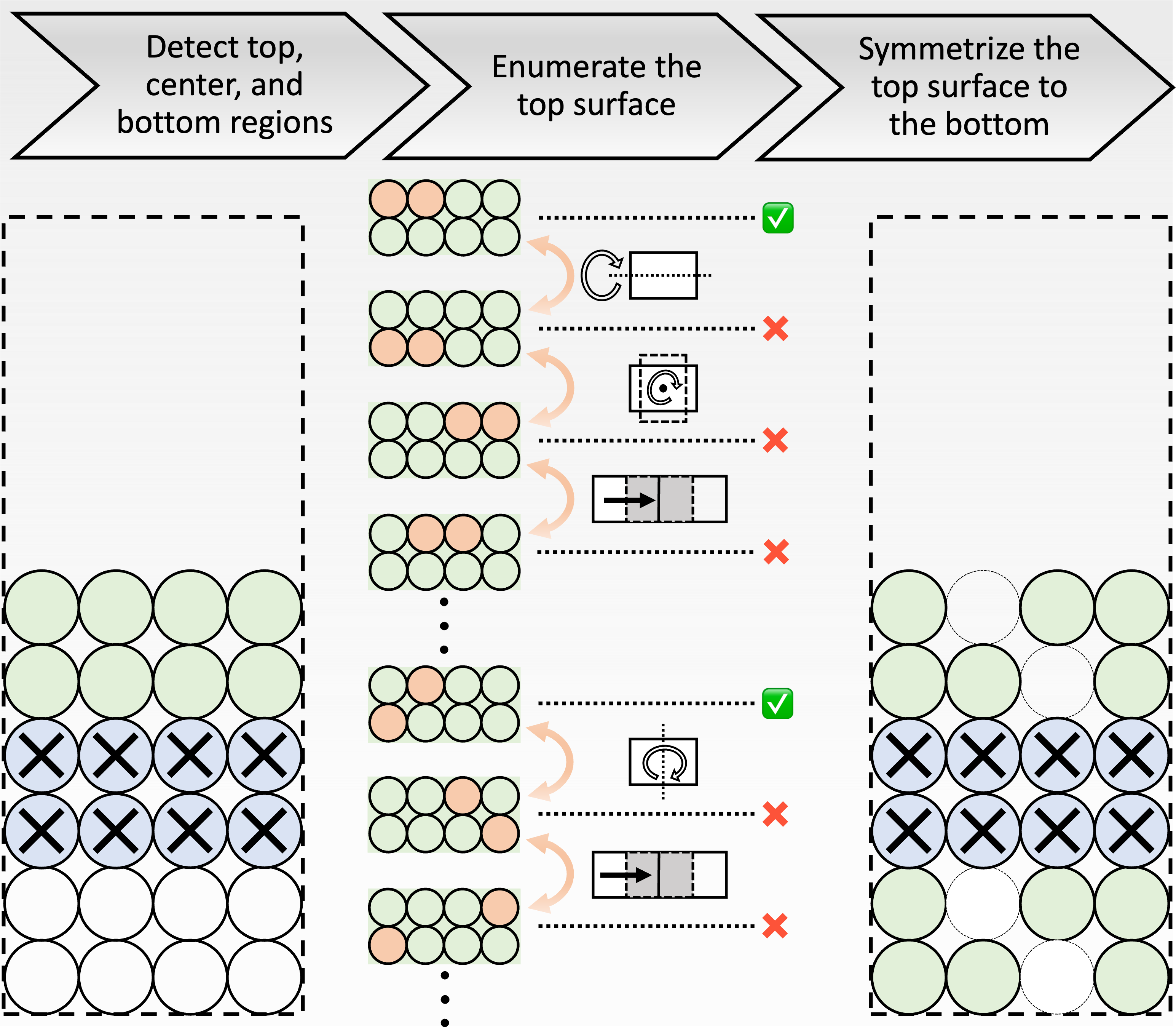
The compound, shape, geometry, sites property of the input slab model will be checked first to make sure the user defined slab model is valid.
The to-be-enumerated composition that user defined will be further checked to make sure it will yield integral number of atoms.
The slab model will be separated as the top, center, and bottom regions according to the statement of constrains defined for all atoms (user defined).
The top and center regions will be combined and create a pseudo slab model.
Surface-pd manages temporary internal marker species before passing the configured surface sites to
SurfaceEnumerator.The “top” surface of the pseudo slab model will be enumerated in 3D to generate all geometrically distinct slab models (a, b, and c lattice parameters are all possible to change).
Applying the filtration steps to remove those enumerated pseudo slab models have c lattice parameter changed since we only want 2D surface enumeration (only a and b lattice parameters are allowed to change).
The remaining enumerated pseudo slab models will be symmetrized on the basis of the inversion symmetry.
The symmetrized “real” slab model will further be refined, which means the atoms will be moved to the expected symmetry positions.
The inversion symmetry center will be shifted to the origin (0, 0, 0) and let VASP determines the point group symmetry and the space group.
Enumlib code
The enumlib code was developed by Prof. Gus Hart’s group by Brigham Young University (BYU).
For the full description of the enumlib code, please refer to its github link and the following papers.
1. Algorithm for generating derivative structures
2. Generating derivative structures from multilattices: Algorithm and application to hcp alloys
3. Generating derivative structures at a fixed concentration
4. Generating derivative superstructures for systems with high configurational freedom